Well, it's been nearly a year since my last post and despite good intentions to fire up this blog again - life has other plans.
Old Jewish joke - stop me if I've told you this one before.
"How do you make God laugh?"
"Tell her your plans!"
I will reveal all later. Meanwhile...
I wish all Pugs a merry Crossmazzle and the same to everyone else too.
Here's this year's offering. Created the same way I did last year's. Lots of separate pencil drawings scanned and composited in Serif Affinity Photo then coloured therein!
Serif Affinity Photo It's like PhotoShop but you don't have to rent it you can buy it and it's cheaper.
A miscellany, a florilegium. Pseudorandom synaptic scintillations from the infinite dusty attic between my ears.
Showing posts with label drawing. Show all posts
Friday, 8 December 2017
Another Crossmuss Looms
Labels:
Affinity Photo,
angel,
christmas,
demon,
drawing,
illustration,
mince pies,
pug,
temptation
Tuesday, 17 February 2015
Monday, 21 July 2014
Knot Again
In a previous post - Get Knotted - I worked out a design for a Celtic cross, used an iPad app to check that it worked and noticed that I could get the design to interlock by slightly overlapping the four units. Using the iPad saved me a lot of drawing, allowed me to mess around with the design, giving me the insight that I could overlap the units.
Int that what puters are for Awa Rich?
The next step was to figure out how to do this with traditional instruments. I'd worked out how to construct a unit in the 'Large Hadron Collider' schematic.
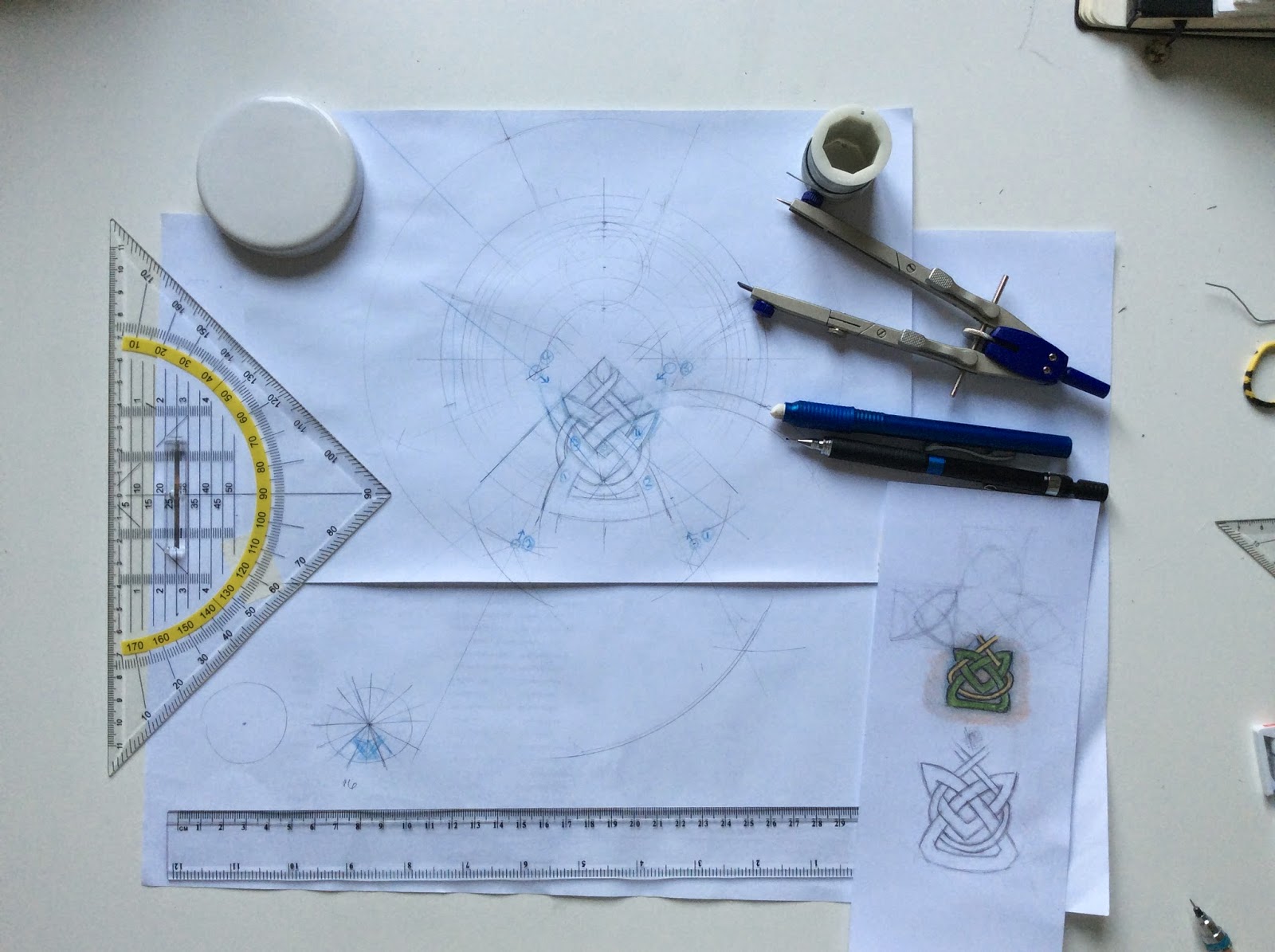
Now all I had to do was repeat the process three more times. This was filling me with some trepidation due to the amount of chaos on the page caused by all the construction lines - which would need a lot of scrubbing out later.
I thought about cutting a cardboard template but that would take some doing and add another layer of inaccuracy. There had to be a way to simplify the construction using only the instruments you can see in the photo. Even so, I'm using technology that wasn't available to 9th century monks - nope, I'm not talking about the iPad - pencils, erasers and paper didn't become available until centuries later.
That's when the holes made by the compass point shone out like a little constellation - you can see I've circled them in the drawing so I could easily find them if I needed to redraw any lines. I already had my template, all I had to do was lay the drawing over a clean sheet of paper and prick through the holes to transfer them to the new sheet, then draw the arcs with the compasses. Rotate the template through 90 degrees and repeat. This proved to be a bit of a faff, it might have been easier to line up the dots if I'd used tracing paper.
It was rotating the template about the central hole that provided the next insight. I remembered technical drawing classes at school, how we were taught how to transfer measurements from one drawing to another using a pair of compasses. This method turned out to be a lot simpler and a clear pattern emerged.
It's amazing how something that seems horribly complicated at first, suddenly simplifies itself if you keep your eyes and brain open. Patterns reveal themselves like magic.
Sometimes you have to go the long way round to discover the shortcut Awa Rich!
Hmm, most sagely. I must write that one down.
Once the positions of the compass points were transferred using the compasses, it was a simple matter of drawing the arcs.
Another insight. I've been referring to each quarter of the drawing as a unit since the whole thing is the same pattern repeated four times rotated through 90 degrees. But notice that each arm of the cross is symmetrical about a line through the centre of the pattern. What I've been thinking of as a unit is actually two smaller units reflected about that line. The cake has 8 slices, not 4.
This reminded me of tedious, dry maths classes at school. Transformations - displacement, rotation, reflection and scaling - and here I was having fun with them.
This post is about a journey. Ideas, patterns, problems and insights that provided solutions - so no explanation of the step by step process is included. I'll do that another time.
Now all I have to do is colour it in.
Int that what puters are for Awa Rich?
The next step was to figure out how to do this with traditional instruments. I'd worked out how to construct a unit in the 'Large Hadron Collider' schematic.
| The 'Large Hadron Collider' Schematic |
Now all I had to do was repeat the process three more times. This was filling me with some trepidation due to the amount of chaos on the page caused by all the construction lines - which would need a lot of scrubbing out later.
I thought about cutting a cardboard template but that would take some doing and add another layer of inaccuracy. There had to be a way to simplify the construction using only the instruments you can see in the photo. Even so, I'm using technology that wasn't available to 9th century monks - nope, I'm not talking about the iPad - pencils, erasers and paper didn't become available until centuries later.
That's when the holes made by the compass point shone out like a little constellation - you can see I've circled them in the drawing so I could easily find them if I needed to redraw any lines. I already had my template, all I had to do was lay the drawing over a clean sheet of paper and prick through the holes to transfer them to the new sheet, then draw the arcs with the compasses. Rotate the template through 90 degrees and repeat. This proved to be a bit of a faff, it might have been easier to line up the dots if I'd used tracing paper.
It was rotating the template about the central hole that provided the next insight. I remembered technical drawing classes at school, how we were taught how to transfer measurements from one drawing to another using a pair of compasses. This method turned out to be a lot simpler and a clear pattern emerged.
It's amazing how something that seems horribly complicated at first, suddenly simplifies itself if you keep your eyes and brain open. Patterns reveal themselves like magic.
Sometimes you have to go the long way round to discover the shortcut Awa Rich!
Hmm, most sagely. I must write that one down.
Once the positions of the compass points were transferred using the compasses, it was a simple matter of drawing the arcs.
Another insight. I've been referring to each quarter of the drawing as a unit since the whole thing is the same pattern repeated four times rotated through 90 degrees. But notice that each arm of the cross is symmetrical about a line through the centre of the pattern. What I've been thinking of as a unit is actually two smaller units reflected about that line. The cake has 8 slices, not 4.
This reminded me of tedious, dry maths classes at school. Transformations - displacement, rotation, reflection and scaling - and here I was having fun with them.
![]() |
| Symmetry |
This post is about a journey. Ideas, patterns, problems and insights that provided solutions - so no explanation of the step by step process is included. I'll do that another time.
Now all I have to do is colour it in.
Tuesday, 15 July 2014
Knot So Fast Buster!
A good place to start telling a story is in the middle. I put this Celtic knot picture in a previous post as an example of a drawing I'd made using the 53 Paper app. on my iPad. It started as a doodle, a warm-up for some other sketches in a proper paper sketchbook, but I reworked it after drawing more of the same with pencils, coloured pencils and watercolour.
Decisions I made while using physical media influencing decisions about the digital image. Using the eraser a lot - much easier in the digital context, though in the 53 Paper app. there is only a hard eraser whereas a real eraser can be more subtle. Real paper can only withstand a certain amount of scrubbing but a digital eraser can rub out as many times as you like.
I like the effect of layering colours you get with coloured pencils, the way you can see the granular texture of the colours in the previous layers. I tried it in the digital image and achieved a fair approximation. A pleasant effect, better than flat colour. Using the pencil tool to draw the thick outlines was useful as I could over draw lines to make them stronger or ease back on others - more like a real pencil and less digital looking than using the pen or marker tool to give a solid line.
Overlaying watercolour glazes creates some interesting effects but nothing like real watercolour.
Finally, a more worked up version done with a combination of watercolour and coloured pencil on Fabriano Accademia Desegno e Acquarello 240 gsm natural grain paper - which is very absorbent for a paper that declares itself suitable for watercolour, though you can achieve some interesting effects once you get used to it.
The absorbency of the paper exaggerates the way watercolours dry lighter than they appear when they're wet. Some colours appear very dark when wet but almost disappear when they dry.
Overlaying watercolour glazes creates some interesting effects but nothing like real watercolour.
Here's a page from my sketchbook with the same design drawn with non photo blue pencil - to establish the design - overdrawn with a 0.5 mm mechanical pencil then coloured with Derwent Studio coloured pencils.
The design below has been outlined with black ink.
Finally, a more worked up version done with a combination of watercolour and coloured pencil on Fabriano Accademia Desegno e Acquarello 240 gsm natural grain paper - which is very absorbent for a paper that declares itself suitable for watercolour, though you can achieve some interesting effects once you get used to it.
The absorbency of the paper exaggerates the way watercolours dry lighter than they appear when they're wet. Some colours appear very dark when wet but almost disappear when they dry.
So, how did I get here? I was marvelling at The Book of Kells on my iPad - get it in the AppStore for the price of an average bottle of wine, you'll be enjoying it long after the wine has gone.
You should go into advertising copywriting - back in the '50s Awa Rich!
I was wondering where you'd got to.
Same here Awa Rich. I was beginning to think you'd abandoned me.
I've been fascinated by Celtic knotwork since I was a kid. My brother Nick and I went through a phase of filling any available piece of paper with intricate designs we called 'creepers' like the tendrils on a pea vine. We'd discovered fractal self similarity, though we didn't know it at the time.
A prize with no bells on it for you Awa Rich!
This made for fertile ground when I got a book about the Vikings from a 'book of the month club'. It had some knotwork design on the cover and/or there were photographs of wood or stone carvings inside. This is all fogged by the passage of time.
That's my version of the story. Nick might remember it differently.
It was Nick that took knotwork as his own thing, beginning with the dust jacket of the Vikings book. The original must have been pretty boring as he replaced it with his own design. From then on, any available surface was fair game. Take a look at his website, there's a link over there on the right.
The design in the image at the top of this post was copied from a small pendant on a troll in a Brian Froud illustration.
All this because I was scratching around some designs for a logo or monogram for my sketchbooks. Actually, a seal to replace the bead on the end of the bookmark ribbon.
Is that the future feature Awa Rich?
One of them, yes.
Monday, 14 July 2014
Messing around with Paper (digital)
I was rummaging around in my drawers - as you do - and came across a pack of Milliput (epoxy putty) and wondered if it was still useable or had it set solid?
Milliput alway reminds me of the sticks of gelignite used by bank robbers in old American black and white gangster movies, I cut a slice from each of the sticks and kneaded them together like a good Peterman (that would be a safe blower Awa Rich) and it was still good. I couldn't resist making a head from the marble sized ball that resulted - having no leaks to fix or cracks to plug.
I'll show you the model when it's finished.
Milliput alway reminds me of the sticks of gelignite used by bank robbers in old American black and white gangster movies, I cut a slice from each of the sticks and kneaded them together like a good Peterman (that would be a safe blower Awa Rich) and it was still good. I couldn't resist making a head from the marble sized ball that resulted - having no leaks to fix or cracks to plug.
The face of this creature put me in mind of Pierrot the clown, so I snuffled around on the Googles for some pictures. Seems I'm not the only one who finds all those Comedia del Arte characters a bit creepy. There was a stunning photograph by a young Swedish art student of a doll, but shot so that it looked like a person. Very beautiful but faintly disturbing. Clowns and dolls, guaranteed to give me the collywobbles. It must have been all those black and white Hammer Horror films I watched in the '60s.
That led me on to drawing on my iPad with the 53 Paper app, probably the simplest graphics app available - limitation being the muse of creativity and all that. Drawing on a computer or iPad with a stylus is a lot more difficult than using the real deal - pencil and paper - but, as with everything, practice makes pretty good. Plus, I find that the different experiences of using a computer and physical materials produce inspirational flashes that have me zipping back and forth between the computer and my drawing table to try out what I've just discovered. Try this at home!
Them would be those transferrable skills you used to teach to YTS trainees Awa Rich.
Indeed.
Them would be those transferrable skills you used to teach to YTS trainees Awa Rich.
Indeed.
I'd been monkeying about with some very basic Celtic knots - for reasons I'll explain later - but wasn't too happy with the drawing on the iPad, so I had another crack at it and was more satisfied with the result. Drawing on the iPad is a good warm-up exercise.
I was thinking about some little characters for a story I'll tell you about sometime and was leafing through a book of Swedish Folk Tales illustrated by John Bauer (are you listening Brian Froud?) After a few abortive attempts at getting the look I wanted, I erased the page and started on a drawing for the Pierrot character inspired by the strangely beautiful doll photo.
I'll show you the model when it's finished.
Labels:
53 Paper,
Celtic knot,
drawing,
illustration,
iPad,
Milliput,
Pierrot,
sketch,
sketching
Sunday, 22 June 2014
Sketching at Fulham Palace
On Friday (20th June) the illustration class from Putney School of Art and Design had a PlayAwayAwayDay at Fulham Palace. Bright Phoebus shone most glorious and a good time was had by all.
Find out about Fulham Palace
Fulham Palace is a haven of tranquility and contemplation in the midst of urban London. It's a great place to sketch as there are usually people around - on Friday there were a couple of school groups and a wedding - several interesting buildings and the recently renovated walled garden which is a lovely place to escape from the hullabaloo to read, sketch, eat your lunch or canoodle - as evinced by several couples who found the sunshine and seclusion highly conducive.
I stayed all day and did two sketches, one in the walled garden and one of the facade of the palace.
Ian is an architect who eschews 'puters and still draws the traditional way. He does fantastic pen and watercolour drawings. I did this sketch on A4 200 gsm cartridge paper with a 3B mechanical pencil and Derwent Studio coloured pencils.
I did this sketch on A4 200 gsm cartridge paper with a 3B mechanical pencil and Rembrandt watercolours using a Pentel waterbrush, which is great for sketching as you don't need a pot of water which can spill all over the parquet floor.
When you visit a museum and Uniformed Security Personnel (What's your USP Awa Rich?) search your bag. They're not looking for Weapons of Mass Destruction, they're after your watercolours, as Ian will relate.
I got the proportions a bit askew, the building is wider than it appears here. Another problem I always have with buildings is dividing up the space between the windows and doors. I think I can do it by eye rather than using a perspective division method, but as you can see - I can't.
Linda asked Ian how he gets his drawings to look so accurate, he just shrugged and replied "years and years of practice". The answer no one wants to hear but know deep in their hearts to be true.
Accept no substitutes eh Awa Rich?
True enough. Now go practice!
p.s. I can thoroughly recommend the coffee and the chocolate brownies in The Drawing Room cafe, I went back twice!
Find out about Fulham Palace
Fulham Palace is a haven of tranquility and contemplation in the midst of urban London. It's a great place to sketch as there are usually people around - on Friday there were a couple of school groups and a wedding - several interesting buildings and the recently renovated walled garden which is a lovely place to escape from the hullabaloo to read, sketch, eat your lunch or canoodle - as evinced by several couples who found the sunshine and seclusion highly conducive.
I stayed all day and did two sketches, one in the walled garden and one of the facade of the palace.
![]() |
| Ian drawing the greenhouses in the Knot Garden |
![]() |
| A gaggle of school children in front of Fulham Palace |
I did this sketch on A4 200 gsm cartridge paper with a 3B mechanical pencil and Rembrandt watercolours using a Pentel waterbrush, which is great for sketching as you don't need a pot of water which can spill all over the parquet floor.
When you visit a museum and Uniformed Security Personnel (What's your USP Awa Rich?) search your bag. They're not looking for Weapons of Mass Destruction, they're after your watercolours, as Ian will relate.
I got the proportions a bit askew, the building is wider than it appears here. Another problem I always have with buildings is dividing up the space between the windows and doors. I think I can do it by eye rather than using a perspective division method, but as you can see - I can't.
Linda asked Ian how he gets his drawings to look so accurate, he just shrugged and replied "years and years of practice". The answer no one wants to hear but know deep in their hearts to be true.
Accept no substitutes eh Awa Rich?
True enough. Now go practice!
p.s. I can thoroughly recommend the coffee and the chocolate brownies in The Drawing Room cafe, I went back twice!
Tuesday, 17 June 2014
It's Full of Cats!
Ten thousand years from now - when we've all gone to our accounts impenitent - and Tony Robinson is digging up the internet only to discover it's made entirely from cats - I want the Akashic record to show that I made a small but significant contribution.
The cup of my drafts folder runneth over with incompleteness so here's a bit of silliness to tide you over until the next post.
Oh the bugles played the next post in chorus, and the pipes played the flowers of the forest.
Mr. Foo is my downstairs neighbour's cat. I don't want to know that he's really called Keith or Fankle J. Roosevelt. He sits on the window sill surveying his domain, looking like an old Mandarin.
I didn't utter a word Awa Rich.
I drew him with Derwent Coloursoft pencils.
Labels:
cat,
cats,
colored pencil,
coloured pencil,
Derwent Coloursoft,
drawing,
Fankle,
illustration,
Mandarin,
sketch,
sketching,
Tony Robinson
Subscribe to:
Posts (Atom)


